RSA (Rivest–Shamir–Adleman)
The original public-key algorithm: encrypt with a public key, decrypt with the private one, sign with the private key. Its security comes from how hard it is to factor a large number.
What it is
RSA, published in 1977, was the first practical public-key scheme and still shows
up everywhere in TLS certificates and signatures. The public key (n, e) is
shared freely; the private key (n, d) is kept secret. Anyone can encrypt to you
or verify your signature with the public key, but only you can decrypt or sign.
Security rests on the factoring problem: n is the product of two large secret
primes p and q, and recovering them from n is infeasible at modern sizes.
How it works
Key generation:
- Pick two large random primes
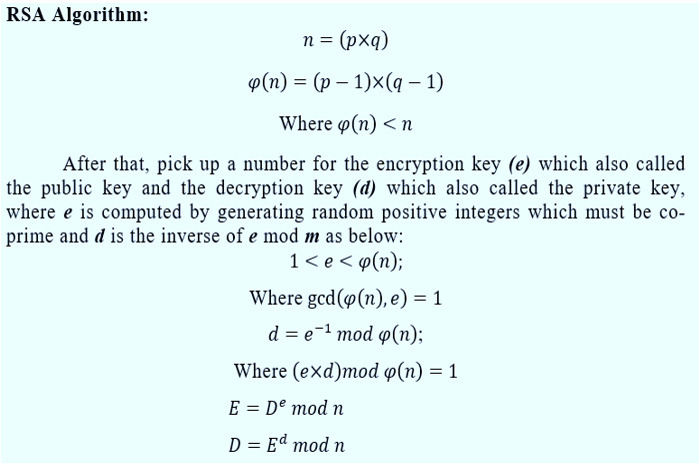
p,qand setn = p·q. - Compute
φ(n) = (p−1)(q−1). - Choose
ecoprime toφ(n)— almost always 65537. - Compute the private exponent
d = e⁻¹ mod φ(n).
Then for 0 ≤ m < n:
- Encrypt:
c = mᵉ mod nDecrypt:m = c^d mod n - Sign:
s = m^d mod nVerify:m == sᵉ mod n
It works because raising to e then d is the identity mod n (Euler's theorem).
When to use it
- Fine for certificates and signatures, but new systems increasingly prefer elliptic curves (Ed25519, ECDSA) for smaller, faster keys.
- Always use padding — OAEP for encryption, PSS for signatures. Textbook RSA
(raw
mᵉ) is insecure: deterministic and malleable. - RSA can only encrypt data smaller than the key, so it wraps a symmetric key rather than bulk data. See symmetric vs. asymmetric.
- 2048-bit minimum (~112-bit security); 3072-bit for longer horizons.
Example (Python)
Concise core showing the math. In production use a vetted library (PyCA
cryptography) that handles OAEP/PSS padding and safe key sizes.
def keygen(p, q, e=65537):              # real keygen picks p, q at random
    n, phi = p * q, (p - 1) * (q - 1)
    return (n, e), (n, pow(e, -1, phi))

def encrypt(m, pub):  n, e = pub;  return pow(m, e, n)
def decrypt(c, priv): n, d = priv; return pow(c, d, n)
Real prime generation uses Miller-Rabin.
Can the primes just be precomputed?
No. RSA-2048 uses two random ~1024-bit primes. There are about 10^305 primes that
size — storing them all would take ~10^307 bytes (~10^295 TB), far more than the
universe can hold. Factoring n directly is the other route, and the best known
algorithm (GNFS) rates RSA-2048 at ~112-bit security; it has never been broken.
The full worked numbers are in the Cryptography FAQ.
Security notes
- Never use raw/textbook RSA — use OAEP for encryption and PSS for signatures.
- Reusing a prime across two keys, or weak randomness in prime generation, breaks everything — see why randomness matters.
- Vulnerable to quantum computers via Shor's algorithm — see ML-DSA.
See also
- ECDSA / Ed25519 — smaller-key signature alternatives
- Miller-Rabin — how the primes are found
- Blind signatures — RSA signing without seeing the message
- ElGamal / HPKE — other ways to encrypt to a public key
- Cryptography FAQ — key sizes, precomputation, quantum
References
- RFC 8017: PKCS #1 RSA Cryptography Specifications v2.2
- Public-key cryptography — Wikipedia